You Never Outgrow the Basics (Even If You Think You Did)
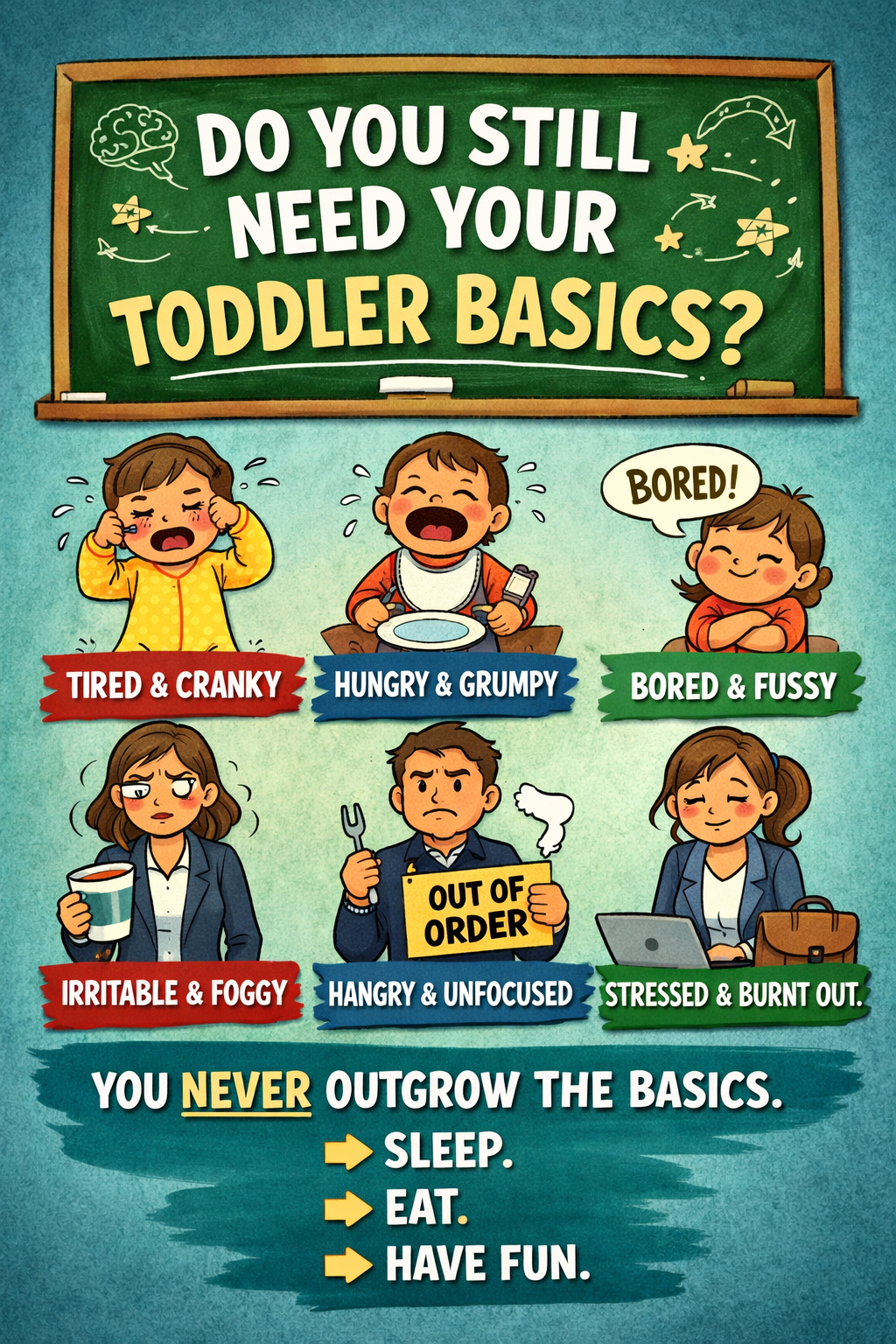
After more than 30 years in the mental health field, you’d think I’d have some sort of complex, highly sophisticated formula for helping people feel better.
Something impressive.
Something with a lot of steps.
Preferably something with a chart.
And to be fair—I’ve tried.
I’ve trained in trauma, sexual trauma, couples work, neurodivergence, ADHD, mood disorders, insomnia, CBT-I… you name it. I genuinely love learning. I’m that therapist who signs up for another training and thinks, “Yes, this is exactly what my brain needed.”
I’ve spent decades diving into neural pathways, behavior patterns, emotional regulation, and the latest research on how the brain works.
And yet…
No matter how complex things get, I find myself coming back to the same three questions, over and over again:
👉 Are you sleeping?
👉 How are you eating?
👉 Are you having any fun?
Let Me Explain It the Way I Often Do in Session
I’ll ask clients:
“Think about a toddler. What happens when they’re tired?”
And almost everyone says the same thing:
They get cranky
They melt down
They can’t regulate
Then I ask:
“When do you outgrow that?”
And the answer is… you don’t.
We just get older and better at disguising it.
Instead of a full meltdown in the middle of a grocery store, it shows up as:
Irritability
Snapping at people
Trouble focusing
Feeling overwhelmed by things that normally wouldn’t be a big deal
Now let’s talk about food.
“What happens when a toddler is hungry?”
Again:
Cranky
Crying
Dysregulated
“When do you outgrow that?”
You don’t.
As adults, it just sounds more like:
“I don’t know why I feel off today”
Brain fog
Low patience
Anxiety that seems to come out of nowhere
And then the one people don’t expect:
“What happens when a toddler is over-structured, overtired, and hasn’t had time to just play or relax?”
Same answer.
Because humans—at any age—aren’t designed to just function, produce, and push through.
We need:
Downtime
Enjoyment
Moments where we’re not “on”
So What Does This Mean?
After decades of training, here’s the irony:
We are incredibly complex…
but our foundations are not.
Sleep.
Fuel.
Joy.
When those are off, everything else becomes harder:
Emotional regulation
Focus
Coping with stress
Relationships
And then we start asking, “What’s wrong with me?”
A Better Question
Instead of jumping straight to:
“What’s wrong with me?”
Try:
Am I sleeping?
Am I eating regularly?
Do I have anything in my life that actually feels good?
Not perfect. Not optimized. Just… present.
A Quick Note on Movement
You’ll notice I didn’t list exercise as its own category.
That’s intentional.
Because for a lot of people, “exercise” feels like pressure.
But movement—gentle, realistic movement—supports everything:
Better sleep
Improved mood
More energy
Sometimes it’s not a workout.
Sometimes it’s just:
A walk
Stretching
Getting out of the “stuck” feeling in your body
The Bottom Line
After 30 years, here’s what I know:
You never outgrow your basic needs.
You just get better at ignoring them.
So before you assume something is deeply wrong…
Come back to the basics.
Sleep.
Eat.
Live a little.