Confessions of an Ex-Super Sleeper: Why Everything Feels Worse When You Don’t Sleep
I used to think sleep problems were… a little overblown.
Not because I didn’t believe people—
but because sleep was my superpower.
I could fall asleep anywhere.
At any time.
Bed? Obviously.
Couch? No problem.
Car ride? Out in five minutes (my record 108 seconds; I mean that’s a gold medal time!)
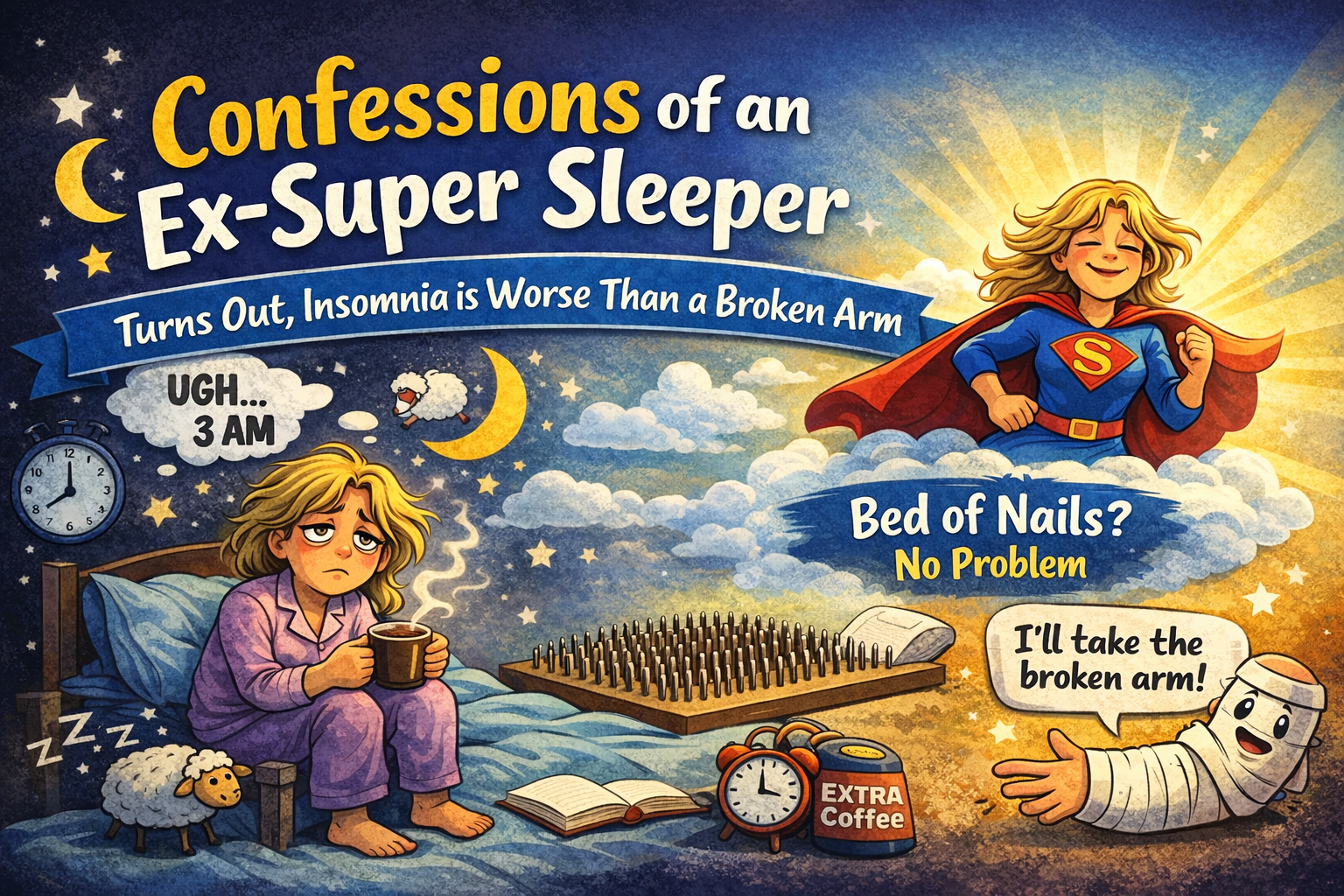
Pretty sure I could’ve managed a bed of nails if needed.
People would look at me like I had some sort of magical gift.
And honestly? I kind of thought I did.
And then… I stopped sleeping.
There was a period of time where my sleep was inconsistent at best—and at times, nonexistent.
And I remember thinking at 3 a.m.:
“What is worse than this?”
Broken arm?
Nope. I’ll take the broken arm.
Because here’s what I didn’t understand until I experienced it:
When you don’t sleep, everything changes.
Your brain doesn’t work the same
Your emotions are all over the place
Your patience disappears
Even small things feel… massive
And suddenly, it’s not just about being tired.
It’s about feeling like you’re not yourself.
Let’s go back to toddlers for a second
What happens when a toddler is overtired?
They melt down.
They cry.
They lose all ability to regulate.
Now—when do you outgrow that?
You don’t.
You just (hopefully) stop throwing yourself on the floor in the middle of a store.
Instead, it shows up as:
Irritability
Snapping at people
Brain fog
Feeling overwhelmed by things that normally wouldn’t be manageable
Same brain. Just better public behavior.
The good news? Sleep is actually treatable.
CBT-I (Cognitive Behavioral Therapy for Insomnia) is the gold standard.
And here’s the part people are always surprised by:
👉 There are free, evidence-based tools out there (yes—paid for by your tax dollars).
Download the Mental Health and Behavioral Therapy Apps | VA Mobile
Including:
Sleep diaries
Assessments
Structured strategies
Psychoeducation that actually makes sense
Let’s talk about the basics (that actually work)
🛏️ Your bed has one job
Sleep. (And yes, sex.)
If you’re:
scrolling
worrying
watching TV
Your brain starts associating your bed with being awake.
We want:
Bed = sleepiness.
⏰ Consistency beats perfection
Going to bed and waking up around the same time every day helps regulate your internal clock.
Not perfect. Just consistent.
🧠 When your brain won’t shut off (aka 2 a.m. negotiations)
Keep a notebook next to your bed.
Yes—actual paper. We are not opening our phones at 2 a.m. That is how you end up on email, social media, or somehow watching videos you don’t even remember clicking on.
If your brain starts spinning:
Write the thought down
Ask: Can I do anything about this right now?
If yes (rare at 2 a.m.): do it quickly.
If no: write down when you will deal with it
Even if it’s:
“Tomorrow at 4pm—I will think about this.”
Your brain doesn’t need it solved.
It just needs to know it’s scheduled.
🧠 Bonus: Brain dump before bed
About an hour before sleep, write everything that’s in your head.
No organizing. No fixing. Just get it out.
☀️ In the morning… greet the sun
I know. It sounds a little cheesy.
But light exposure in the morning helps your brain know when to be awake—and when to be tired later.
☕ Caffeine reality check
At some point, many of us realize:
We can no longer drink caffeine at night and “sleep like a baby.”
Caffeine sticks around longer than we think—often 5–7+ hours (and longer as we age).
Translation:
That afternoon coffee might still be hanging out at bedtime.
🎈 The balloon analogy
Think of your day like blowing up a balloon.
By bedtime, you want it full—ready to pop into sleep.
Every nap?
You let air out.
😴 If you need a nap
Keep it short:
👉 20–30 minutes max
Otherwise, you risk feeling worse and messing with nighttime sleep.
🌙 Don’t miss your sleep window
You know that moment where you’re:
cozy
tired
starting to drift
And then you think:
“I’ll just finish this one thing…”
And suddenly—you’re wide awake.
You didn’t break your sleep.
You just missed the wave.
Sleepiness comes in cycles.
When it shows up, it’s your brain saying: now would be ideal.
The bottom line
Before asking:
“What’s wrong with me?”
Ask:
Am I sleeping?
Am I giving my brain what it needs?
Because after all these years—and after experiencing it myself—
I can tell you this:
A lot of what feels like anxiety, irritability, or overwhelm…
Is actually exhaustion in disguise.
Coming soon…
If your brain still won’t shut off even when you are exhausted…
We’re going to talk about that next.
(Also known as: anxiety, stress, and why your brain picks 2 a.m. to solve your entire life.)
Coming soon…
If your brain still won’t shut off even when you are exhausted…
(Also known as: anxiety, stress, and why your brain picks 2 a.m. to solve your entire life.)