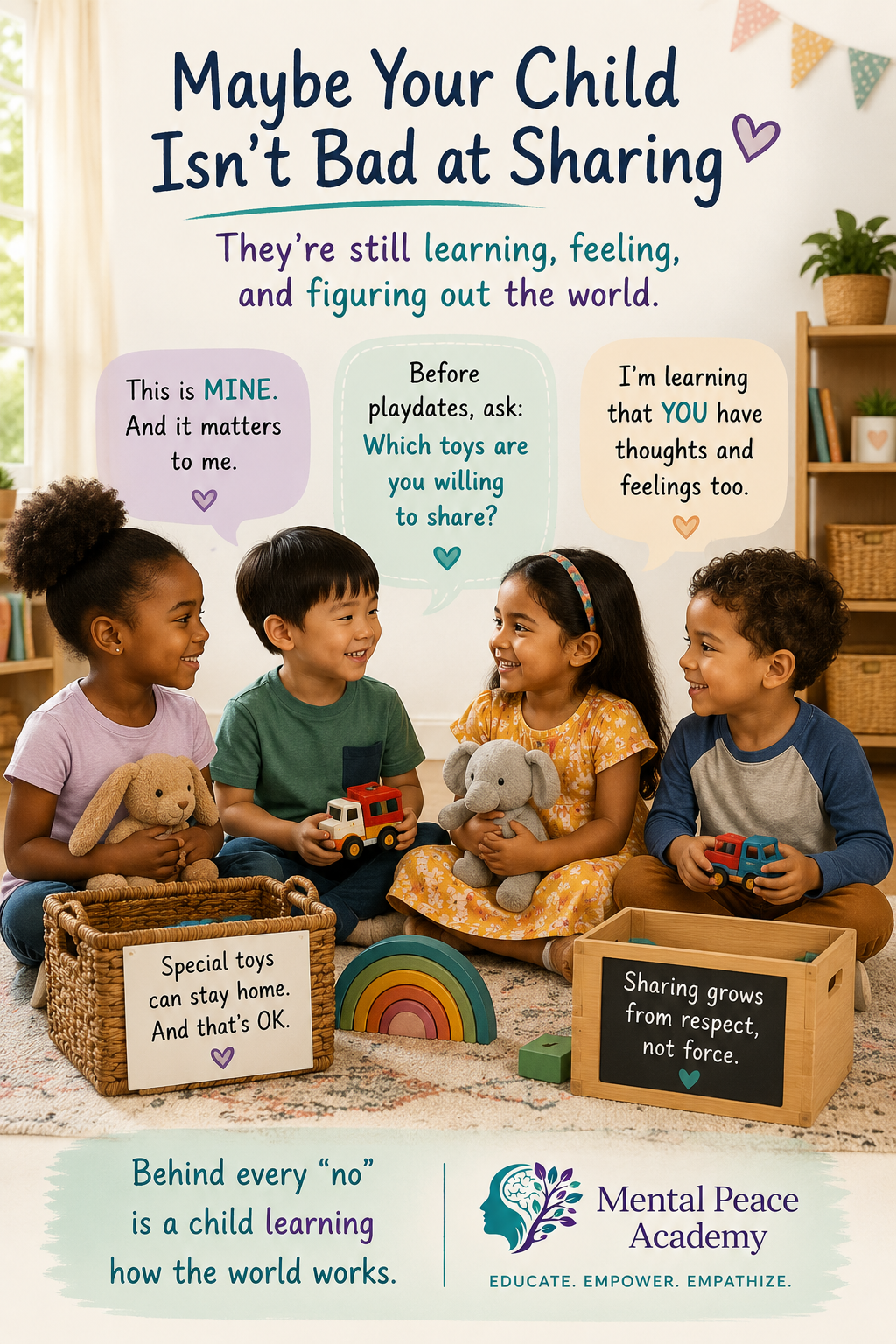
Maybe Your Child Isn't Bad at Sharing
A question for caregivers:
Imagine you're standing in line at the grocery store.
You've carefully selected your items. You've pushed your cart all around the store. You've invested time and energy into filling it.
Suddenly, a complete stranger walks up and says:
"Excuse me. You've had that cart long enough. It's my turn now."
You'd probably stare at them for a second and wonder if this was some sort of social experiment.
And yet...
We ask children to do something remarkably similar every day.
"Share."
And when they don't?
We worry.
We wonder if they're selfish.
We wonder if they're spoiled.
We wonder if we've somehow failed Parenting 101.
But what if they're actually behaving exactly as their developing brain is supposed to?
One of the biggest misconceptions about child development is that sharing should come naturally.
It doesn't.
In fact, children understand ownership long before they understand sharing.
Researchers have found that even very young toddlers understand concepts like:
👉 Mine.
👉 Yours.
Long before they fully understand:
👉 How someone else feels about it.
And honestly, that makes sense.
Children often develop strong attachments to their belongings very early in life.
Their favorite stuffed animal.
Their blanket.
Their special toy.
Their water bottle.
To us, it might just look like a stuffed giraffe missing one eye and most of its stuffing.
To them?
It's priceless.
Think about it this way.
If someone asked you to hand over your wedding ring, your phone, or the photo album that contains every picture of your children, would you happily say:
"Of course! Take it for a while."
Probably not.
Because ownership creates emotional attachment.
Children aren't that different.
The objects are different.
The feelings aren't.
This is where something called Theory of Mind enters the picture.
Between roughly ages 3 and 6, children begin developing the ability to understand that other people have thoughts, feelings, desires, and perspectives different from their own.
This is a huge developmental milestone.
Before that, children often assume everyone experiences the world exactly the way they do.
As Theory of Mind develops, children begin realizing:
👉 Other people want things.
👉 Other people have feelings.
👉 Other people may feel disappointed.
And this is where genuine sharing begins.
Not because they're forced to.
Because they're beginning to understand another person's experience.
Which brings me to a slightly controversial therapist opinion.
Sharing isn't really sharing if it's forced.
It's compliance.
Real sharing involves choice.
And choice is what helps empathy grow.
Before a playdate, I often encourage parents to ask:
"What toys are you willing to share today?"
And:
"Are there any special toys you'd like to put away?"
Parents are sometimes surprised when I say this.
But let's be honest.
Most adults do exactly the same thing.
When guests come over, we don't hand them every possession we own.
Some things are simply special.
Some things are expensive.
And some things...
Well, some things are around that one friend.
You know the one.
The friend who somehow manages to spill coffee, break a chair, knock over a lamp, and lose a phone charger all within a single visit.
We love them.
We just don't hand them the fragile family heirloom.
Children notice these things too.
They know which friends are gentle.
They know which friends color on things.
They know which friends somehow leave a trail of destruction behind them like a tiny tornado in Velcro sneakers.
It's perfectly reasonable for a child to decide that certain toys feel too special to risk.
When children know they have some control over their belongings, something interesting often happens.
They become more willing to share the things they have chosen to share.
Because they feel respected.
And when children feel respected, cooperation tends to increase.
The goal isn't to force generosity.
The goal is to help children develop:
👉 empathy
👉 perspective-taking
👉 emotional security
👉 confidence in making thoughtful choices
Because those are the skills that eventually create genuine kindness.
So the next time your child hesitates to share their favorite toy, try seeing it from a different perspective.
Maybe they're not being selfish.
Maybe they're simply protecting something that matters to them.
And maybe that's a very human thing to do.
After all, most adults aren't handing strangers their wedding rings either.