Why Does My Child Keep Everything?Understanding Kids Who Have Trouble Letting Go
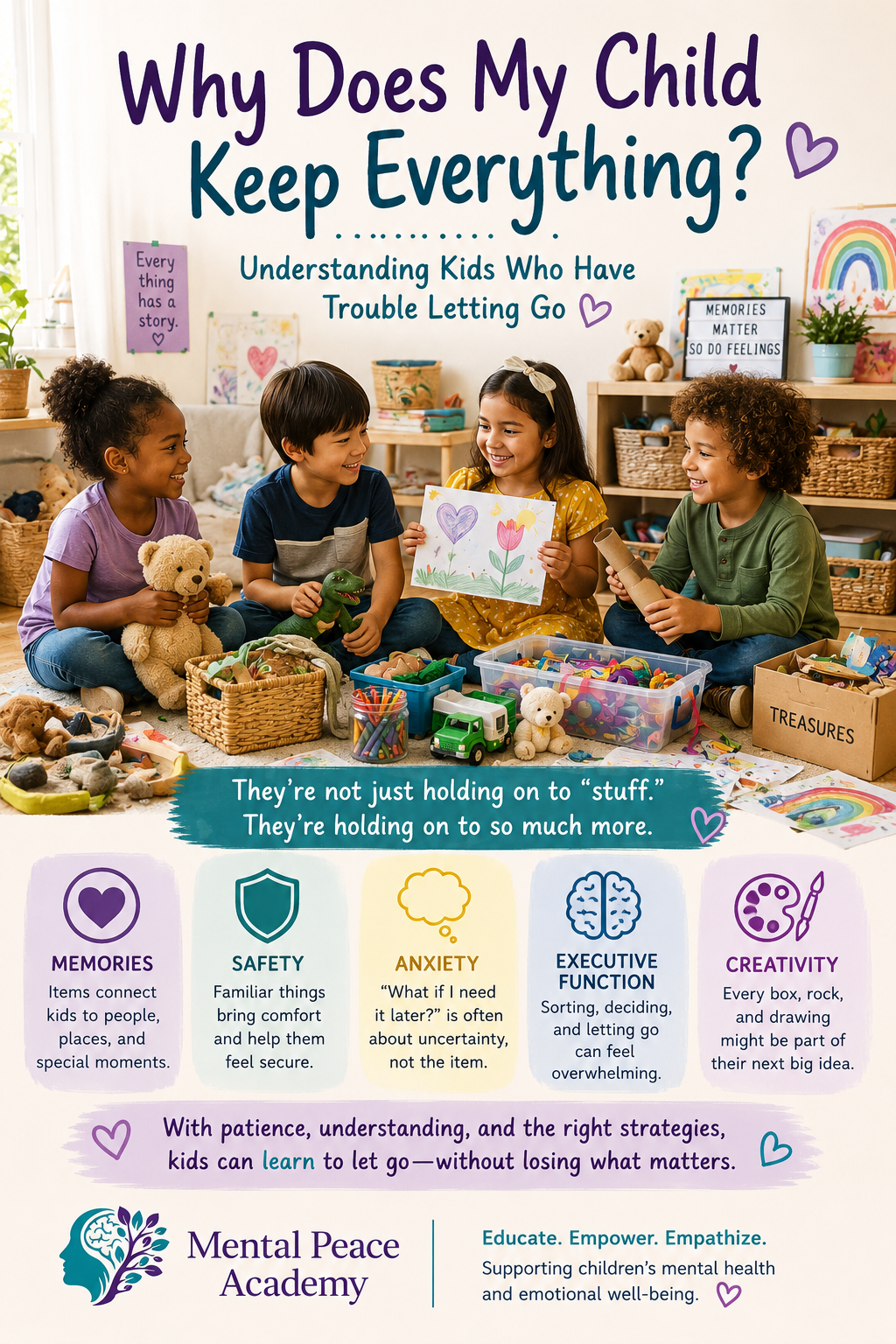
From stuffed animals and artwork to rocks, boxes, and mysterious treasures, many children struggle to let go of their belongings. Learn how attachment, anxiety, executive functioning, creativity, and childhood development all play a role—and what parents can do to help.
You open your child's bedroom door.
A stuffed animal avalanche narrowly misses your face.
You pause.
Survey the landscape.
There are:
seventeen stuffed animals on the bed
three more on the floor
a collection of rocks that apparently cannot be touched
artwork from kindergarten
mysterious treasures from a vacation five years ago
a broken toy that hasn't worked since the Obama administration
And somehow...
Every single item is essential.
Sound familiar?
If you've ever suggested donating, recycling, or parting with even one of these treasures, you've probably heard:
"No."
Followed by:
"But I NEED that."
And perhaps:
"What if I need it someday?"
As parents, it's tempting to assume our children are being stubborn, spoiled, or dramatic.
But more often than not, something deeper is going on.
It Might Not Be About the Stuff
One of the biggest misconceptions we have about clutter is that it's about the objects.
For many children, it isn't.
It's about what the objects represent.
A stuffed animal isn't just a stuffed animal.
It's the bear Grandma gave them.
The rock isn't just a rock.
It's the rock they found on vacation.
The broken toy isn't just a broken toy.
It's a memory.
A feeling.
A connection.
Children are often much more sentimental than we give them credit for.
In fact, many adults are too.
The only difference is that we've become slightly better at hiding it.
We call it a "memory box."
Or an attic.
Or, if you're anything like me, an entire drawer full of things you're definitely going to need someday.
(You won't. But let's not talk about that right now.)
The Brain Loves Safety
Our brains are constantly trying to answer one question:
👉 "Am I safe?"
For some children, possessions become part of that answer.
Certain objects provide:
comfort
predictability
familiarity
emotional security
This is especially common during periods of change:
moving
divorce
starting school
changing schools
family stress
friendship changes
When life feels uncertain, holding onto familiar things can feel reassuring.
Adults do this too.
We just tend to call it "being sentimental."
Sometimes Anxiety Shows Up as "What If?"
One phrase I hear often is:
"What if I need it later?"
This is often less about the object and more about uncertainty.
Children with anxiety frequently struggle with letting go because their brains are trying to prepare for every possible future scenario.
And let's be honest.
If you've ever kept an old phone charger for a device you no longer own because "you never know," you're in the same club.
ADHD and Executive Function Matter Too
Sometimes the issue isn't emotional attachment at all.
Sometimes it's executive functioning.
Children with ADHD and other neurodivergent profiles often have difficulty sorting, categorizing, prioritizing, and making decisions.
To them, deciding what stays and what goes can feel overwhelming.
When the brain becomes overwhelmed, a very common response is:
"Keep everything."
No decision required.
Problem temporarily solved.
Sometimes It's Not Clutter—It's Creativity
Then there are the creators.
You know the children I'm talking about.
The ones who see a cardboard box and don't see recycling.
They see a spaceship.
A castle.
A robot.
Possibly all three at the same time.
Their rooms are often filled with:
artwork
unfinished projects
collections
craft supplies
inventions that make perfect sense to them and absolutely no sense to anyone else
These children aren't necessarily holding onto things because they're anxious.
They're holding onto possibilities.
To them, every object has potential.
Every creation tells a story.
And every piece of artwork represents time, effort, and imagination.
As adults, we sometimes look at a stack of drawings and think:
"We can't possibly keep all of these."
Meanwhile, the child is thinking:
"I worked really hard on those."
Neither perspective is wrong.
The challenge is finding a balance between honoring creativity and teaching organization.
What Doesn't Usually Work
Let's start with what parents often try:
"You're getting rid of this."
"Pick ten things to donate."
"You have too much stuff."
While well-intentioned, these approaches often trigger anxiety, defensiveness, or power struggles.
Because now we're not talking about objects.
We're talking about security.
Or memories.
Or creativity.
Or all three.
What Helps Instead
Start Small
Don't begin with the favorite stuffed animal.
Or the treasured blanket.
Or the collection they've been curating since age four.
Start with obvious trash.
Build confidence first.
Success creates momentum.
Use a Maybe Box
This is one of my favorite strategies.
Place uncertain items into a box.
Store it somewhere out of sight.
Set a reminder for 30–60 days.
If nobody asks about the item during that time, the decision often becomes much easier.
Sometimes we need distance before we realize we don't actually need something.
Adults may recognize this strategy as:
"The bag of clothes sitting in the trunk of your car waiting to be donated."
Photograph the Memory
Sometimes children don't need the object.
They need the story.
Take a picture.
Create a digital memory album.
Preserve the memory while reducing the clutter.
This works especially well for:
artwork
school projects
collections
vacation treasures
Create a "Greatest Hits" Collection
This is one of my favorite strategies for creative children.
Instead of keeping every drawing, every project, and every creation forever, invite your child to choose their favorites.
Think of it like creating:
a portfolio
a highlight reel
a personal museum
You can:
create a keepsake box
make a scrapbook
build a digital photo album
rotate favorite artwork on display
This teaches an important lesson:
👉 We don't have to keep everything to honor something.
The memory, effort, and pride remain even when the object itself doesn't.
One In, One Out
Simple.
A new stuffed animal comes in.
One older item leaves.
Not because we're being mean.
Because every home has finite space.
Even if children are absolutely convinced their bedroom can somehow expand indefinitely.
The Goal Isn't Less Stuff
The goal isn't creating a minimalist child.
The goal is helping children develop flexibility.
Helping them learn:
👉 "I can appreciate something without keeping it forever."
👉 "I can remember something without owning it."
👉 "I can let go and still be okay."
Those are life skills.
And honestly?
Many adults are still working on them too.
The Bottom Line
Sometimes children hold onto things because they're sentimental.
Sometimes because they're anxious.
Sometimes because they're overwhelmed.
Sometimes because they're creative.
Sometimes because they're human.
Before assuming a child is being difficult, it helps to ask:
👉 "What does this object mean to them?"
Because the answer is often far more important than the object itself.
And if you happen to have a box in your basement labeled "Important Miscellaneous Things" that hasn't been opened in eight years...
This may be your gentle reminder that you're not so different from your child after all.