Stone Age Brains in a 24-Hour News Cycle
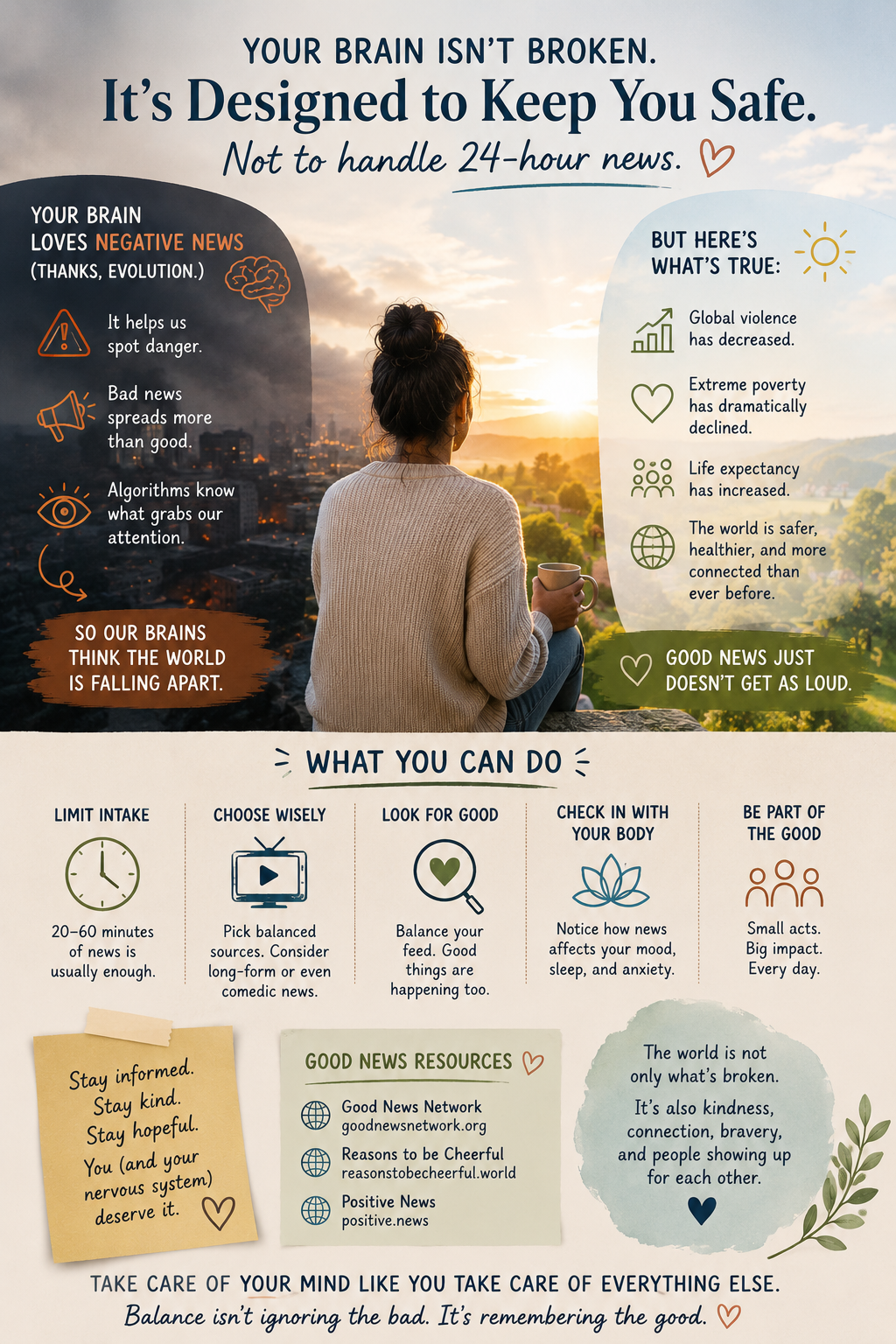
As a therapist, I hear this constantly lately:
👉 “The world feels awful.”
👉 “Everything feels negative.”
👉 “Humanity is doomed.”
And honestly?
I understand why people feel that way.
Because our brains were never designed to absorb:
tragedies from across the world
24-hour breaking news
constant outrage
algorithm-fed negativity
and everyone’s opinions… all day long
Our brains were designed for:
👉 small tribes
👉 immediate threats
👉 and occasionally running from something with large teeth.
Which means:
Your nervous system is essentially operating with Stone Age software in a world of smartphones, notifications, and endless doom-scrolling.
And frankly?
It’s overwhelmed.
Your brain LOVES negative information
Not because you’re pessimistic.
Because your brain is trying to keep you alive.
Psychologists call this the negativity bias.
We naturally pay more attention to:
danger
criticism
conflict
bad news
Because, evolutionarily speaking:
👉 the humans who noticed threats survived.
The overly relaxed caveman saying:
“Honestly, that rustling bush is probably fine…”
did not always pass on his genes.
And this doesn’t just affect survival.
It affects attention and memory too.
Research consistently shows that:
negative information grabs us more quickly
sticks in memory longer
and spreads farther socially than positive information
There’s also longstanding marketing and customer-service research showing people are more likely to share bad experiences than good ones.
(Which explains approximately 87% of internet comment sections.)
The problem?
News and social media algorithms know this.
Negative headlines:
keep attention longer
generate more clicks
increase engagement
And engagement?
👉 makes money.
So what happens?
Your brain starts to believe:
👉 danger is everywhere
👉 people are terrible
👉 the world is collapsing
Meanwhile…
Most of us are:
sitting safely on a couch
drinking coffee
wearing sweatpants
while emotionally preparing for the apocalypse because we read headlines for 45 minutes.
But here’s what’s important
The world is not perfect.
Not even close.
There are real problems that deserve attention.
But there is also something else that’s true:
👉 In many measurable ways, the world has become safer over time.
Examples:
global violent crime rates have decreased over decades in many regions
extreme poverty worldwide has dramatically declined over the last several decades
life expectancy has increased globally
many forms of violence—including some forms of interpersonal violence—have declined significantly since the 1990s in the U.S.
That doesn’t mean suffering doesn’t exist.
It means:
👉 our brains are not always accurate judges of overall reality.
Because your brain confuses exposure with prevalence
If you hear about:
ten tragedies
twenty conflicts
thirty alarming headlines
your nervous system assumes:
👉 “This must be happening constantly everywhere.”
But 99% of human existence was not spent processing nonstop global information.
It was spent:
gathering food
sitting around fires
trying not to freeze
and probably arguing about whose turn it was to deal with the mammoth.
Walter Cronkite may have been onto something
Years ago, people often consumed:
👉 one evening news broadcast
And then they went outside.
Or talked to humans.
Or touched grass.
And interestingly?
News programs often ended with a positive human-interest story.
A reminder that:
👉 goodness still existed too.
Now?
Many people are consuming:
hours of news
social media clips
outrage commentary
and stress… before breakfast.
So what can we do?
First:
👉 Limit intake.
Your nervous system does not need 7 straight hours of “breaking news.”
Most people will stay informed perfectly well with:
20–60 minutes daily
from a reasonably balanced source
Second:
👉 Consider how you consume information.
Some people actually do better getting news through:
calmer formats
long-form journalism
or even comedic commentary
Humor can reduce nervous system intensity while still helping people stay informed.
Third—and this is important:
👉 Intentionally look for good.
Not fake positivity.
Not denial.
Balance.
Because good things are happening too.
Your brain just doesn’t naturally spotlight them.
Some good-news resources
If you want to balance your information diet a little more, try:
The bottom line
Your brain was designed to notice danger.
Not to accurately assess the entirety of humanity through a glowing rectangle at 11pm.
So yes:
stay informed
care deeply
pay attention to real issues
But also remember:
👉 your nervous system needs balance too.
Because the world is not only what’s broken.
It’s also:
kindness
laughter
connection
people helping each other
communities rebuilding
strangers showing up for one another
And your brain deserves reminders of that too.